
Industrial asphalt paving in New Orleans requires specialized materials, construction methods, and careful planning to accommodate heavy truck traffic, frequent deliveries, and Louisiana’s challenging climate. Warehouses, distribution centers, manufacturing facilities, and industrial access roads experience stresses that ordinary parking lots may not be designed to handle. Modern asphalt paving techniques, including improved mixtures, precision equipment, and advanced pavement design, can help create durable surfaces while reducing maintenance costs and operational disruptions. Understanding these innovations helps industrial property owners make informed decisions about new paving, resurfacing, and pavement rehabilitation projects.
Why Industrial Asphalt Paving Requires Specialized Construction
Industrial pavement must accommodate significantly different traffic conditions than a typical retail parking lot.
Heavy delivery trucks, tractor-trailers, forklifts, and other equipment can place substantial loads on paved surfaces. Repeated turning movements, braking, and stationary loading may also contribute to pavement deterioration.
In New Orleans, these challenges are compounded by frequent heavy rainfall, variable soil conditions, and the need for effective drainage.
Professional industrial asphalt paving services should account for the facility’s specific traffic patterns, anticipated loads, and operating requirements.
Common Industrial Asphalt Applications
Industrial asphalt paving may be used for:
- Warehouse and distribution center access roads
- Manufacturing facility parking and circulation areas
- Commercial truck routes and loading approaches
- Industrial storage yards
- Employee and visitor parking areas
- Private roads serving industrial developments
Different areas within the same facility may require different pavement structures.
For example, an employee parking lot generally experiences lighter loads than a truck staging area or loading dock approach.
Sustainable Materials for Industrial Asphalt Paving
Advances in asphalt materials provide opportunities to improve resource efficiency without sacrificing pavement performance.
Reclaimed Asphalt Pavement
Reclaimed asphalt pavement, commonly called RAP, consists of asphalt removed from existing roads and paved surfaces.
This material can be processed and incorporated into new asphalt mixtures when appropriate specifications and quality controls are followed.
Using RAP can reduce demand for virgin aggregates and asphalt binder while diverting reusable pavement materials from disposal.
However, the amount of recycled material suitable for a project depends on the mixture design, performance requirements, and applicable specifications.
Warm-Mix Asphalt Technology
Warm-mix asphalt technologies allow certain mixtures to be produced and placed at lower temperatures than conventional hot-mix asphalt.
Depending on the technology and application, these methods can reduce production energy requirements and associated emissions.
Warm-mix technologies may also provide construction benefits under suitable conditions, but performance depends on proper mixture selection and installation.
Reflective and Cool Pavement Options
Some pavement technologies are designed to reflect more sunlight and reduce surface temperatures.
However, cool pavement treatments are not standard solutions for every industrial asphalt application.
Heavy truck traffic, surface durability, maintenance requirements, and cost must be considered before selecting reflective coatings or specialized pavement systems.
Modern Industrial Asphalt Paving Technologies
Modern paving equipment and quality-control methods help contractors achieve more consistent pavement construction.
These technologies can improve accuracy, reduce material waste, and support better long-term performance.
GPS and Grade-Control Equipment
GPS-assisted and other automated grade-control systems can help contractors establish appropriate pavement elevations and surface slopes.
Accurate grading is particularly important for industrial facilities where large paved areas must direct water toward drainage structures.
The specific technology used depends on the project, equipment, and construction requirements.
Infrared Temperature Monitoring
Temperature consistency is important during asphalt placement and compaction.
Infrared temperature monitoring can help identify cooler areas in newly placed asphalt that may be associated with temperature segregation.
These areas may require closer evaluation because inconsistent temperatures can affect compaction and pavement performance.
Infrared monitoring does not directly measure pavement density or guarantee that a surface is free from defects.
Modern Compaction Equipment
Proper compaction is essential for durable industrial asphalt.
Modern rollers and density-monitoring technologies can help contractors achieve more consistent compaction across paved areas.
Insufficient compaction may leave excessive air voids, allowing moisture infiltration and increasing the risk of premature deterioration.
Quality-control testing remains important for verifying that construction meets project specifications.
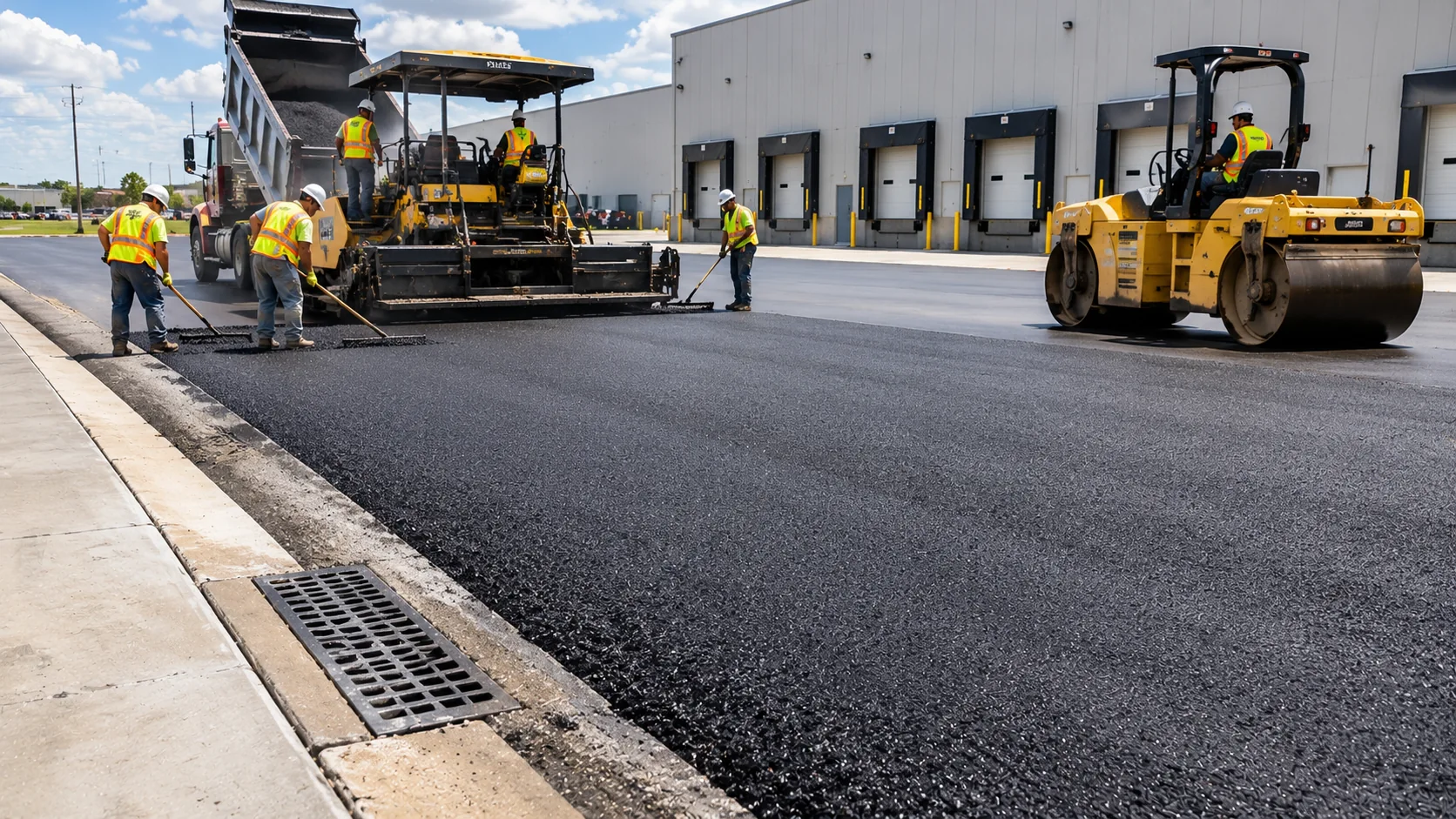
Professional asphalt paving equipment and proper compaction help create durable surfaces capable of supporting heavy industrial traffic.
Designing Asphalt for Heavy Industrial Traffic
Industrial asphalt pavement must be designed to accommodate anticipated vehicle loads and traffic frequency.
The appropriate pavement thickness depends on several factors, including truck weights, repeated loading, foundation strength, and drainage conditions.
Preventing Rutting and Surface Deformation
Rutting occurs when repeated vehicle loads cause permanent depressions in pavement.
Industrial facilities may experience rutting in truck wheel paths, loading areas, and locations where vehicles brake or turn frequently.
Appropriate asphalt mixtures, sufficient pavement thickness, proper compaction, and stable foundations help reduce this risk.
Polymer-modified asphalt binders may improve rutting resistance in suitable applications.
Heavy Loads and Stationary Equipment
Areas where heavy vehicles remain stationary or repeatedly turn can experience concentrated pavement stresses.
In some cases, concrete pavement or specialized pavement structures may be more appropriate than conventional asphalt.
A professional evaluation helps determine the best material and design for each part of an industrial facility.
Site Preparation and Soil Stability
A durable industrial asphalt surface depends on the condition of the materials beneath it.
New Orleans properties may encounter soft, compressible, or moisture-sensitive soils that require additional attention during construction.
If the foundation cannot adequately support heavy loads, pavement may crack, settle, or develop ruts even when high-quality asphalt materials are used.
Evaluating Existing Conditions
Before construction, contractors should assess the site’s drainage, existing pavement condition, and anticipated traffic requirements.
Depending on the project, geotechnical testing may be appropriate to evaluate soil strength and stability.
Building a Stable Foundation
Site preparation may involve excavation, subgrade compaction, stabilization, or installation of appropriate aggregate base materials.
For industrial facilities, pavement design should account for repeated heavy-vehicle loading and the potential effects of moisture on foundation strength.
Proper foundation construction is essential for reducing long-term maintenance problems.
Improving Safety and Drainage at Industrial Facilities
Industrial paving must support safe vehicle circulation and daily facility operations.
Heavy trucks, delivery vehicles, forklifts, and employee traffic may share portions of the same paved area.
Proper pavement design can help reduce hazards and improve traffic flow.
Drainage for Louisiana’s Heavy Rainfall
New Orleans’ frequent rainfall makes effective drainage especially important.
Standing water can create operational problems and contribute to pavement deterioration when moisture enters cracks or weakens the supporting base.
Appropriate grading, drainage channels, catch basins, and other stormwater infrastructure help direct runoff away from paved surfaces.
Surface Texture and Traffic Circulation
Pavement texture, appropriate markings, and clearly defined traffic routes can support safer vehicle movement.
Industrial facilities may benefit from designated truck lanes, loading zones, pedestrian routes, and parking areas.
Paving design should also consider turning radii and the space required for large vehicles to maneuver.
Asphalt Resurfacing vs Full Reconstruction
Not every deteriorated industrial pavement requires complete replacement.
The appropriate rehabilitation method depends on the condition of the existing asphalt and its supporting foundation.
When Asphalt Resurfacing Makes Sense
Resurfacing involves installing a new asphalt layer over a properly prepared existing pavement.
This may be appropriate when the surface is worn but the underlying structure remains capable of supporting anticipated loads.
Localized repairs and drainage corrections may be necessary before resurfacing.
When Reconstruction Is Necessary
Extensive structural cracking, severe rutting, widespread settlement, or foundation failure may require removal and replacement of the pavement structure.
Reconstruction provides an opportunity to address inadequate base materials, unstable soils, and drainage problems.
For industrial facilities, correcting these underlying conditions is particularly important because heavy vehicle loads can accelerate recurring failures.
Preventive Maintenance for Industrial Asphalt
Regular maintenance helps industrial property owners protect their paving investment.
High-traffic areas should be inspected for cracking, rutting, potholes, drainage problems, and other signs of deterioration.
Recommended maintenance activities include:
- Inspecting truck routes and loading areas regularly
- Sealing appropriate cracks before water penetrates the pavement
- Repairing potholes and localized failures promptly
- Keeping drainage structures clear of debris
- Monitoring high-load areas for rutting and settlement
- Evaluating resurfacing needs before structural deterioration becomes widespread
Maintenance schedules should reflect actual traffic conditions rather than relying on a fixed interval for every facility.
For more information about local roadway challenges, read our article on street paving challenges and innovations in New Orleans.
Choosing an Industrial Asphalt Paving Contractor
Industrial paving projects require careful coordination to minimize disruptions to facility operations.
When evaluating contractors, property owners and facility managers should consider experience with heavy-duty pavement construction and projects involving commercial vehicle traffic.
Important questions include:
- Has the contractor completed similar industrial paving projects?
- How will anticipated truck loads affect pavement design?
- Will drainage and foundation conditions be evaluated?
- What asphalt materials and pavement thickness are proposed?
- Can construction be phased to maintain facility access?
- What quality-control procedures will be used?
- Are the project scope, schedule, and warranty terms clearly documented?
For additional technical information about pavement materials and construction practices, visit the Federal Highway Administration’s pavement resources.
Selecting an experienced contractor helps ensure the proposed paving solution addresses the facility’s actual operating conditions.
Modern Paving Solutions for New Orleans Industries
Modern industrial asphalt paving in New Orleans combines improved materials, professional installation methods, stable foundations, and effective drainage to create durable pavement surfaces.
For warehouses, manufacturing facilities, distribution centers, and other industrial properties, pavement performance directly affects transportation efficiency and daily operations.
Chris Paving LLC provides asphalt paving, resurfacing, and repair services throughout New Orleans and surrounding Louisiana communities.
Whether you’re planning a new industrial access road, rehabilitating a truck parking area, or repairing deteriorated pavement, our team can help evaluate your paving requirements.
Contact Chris Paving LLC today to discuss your industrial paving project and request a free estimate.