
Choosing between asphalt vs concrete roads in Baton Rouge involves more than comparing installation costs. Louisiana’s intense summer heat, frequent heavy rainfall, variable soil conditions, and demanding traffic loads can all affect pavement performance. Whether you’re planning a private road, commercial access road, subdivision street, or roadway improvement, understanding the advantages and limitations of each material is essential. Both asphalt and concrete offer durable paving solutions when properly designed and installed, but the right choice depends on your project’s specific requirements.
Understanding Asphalt vs Concrete Roads
Asphalt and concrete are two of the most widely used materials for constructing roads and paved surfaces. Both provide dependable performance, but their composition, installation methods, maintenance requirements, and long-term costs differ.
Asphalt is a flexible pavement material that typically offers faster installation and easier surface repairs. Concrete is a rigid pavement material known for its load-bearing capacity and potentially longer service life.
For Baton Rouge property owners, choosing between these materials requires evaluating traffic conditions, drainage, construction budgets, and expected maintenance needs.
What Are Asphalt and Concrete Made Of?
Asphalt pavement consists primarily of crushed stone, sand, and other aggregates bound together with asphalt binder, a petroleum-derived material. The mixture is placed and compacted to create a relatively flexible pavement surface.
Concrete pavement is made from cement, water, fine aggregates, and coarse aggregates. As the cement hydrates, the mixture hardens into a rigid surface capable of distributing substantial vehicle loads.
Both materials can be engineered for specific roadway applications, including commercial access roads, private streets, and high-traffic areas.
Installation Time and Construction Process
Asphalt is generally faster to install and can often be opened to traffic relatively soon after placement and cooling, depending on the pavement design and project conditions.
Professional asphalt paving services in Baton Rouge typically involve site preparation, grading, base construction, asphalt placement, and compaction.
Concrete installation involves preparing the foundation, placing and finishing the concrete, constructing appropriate joints, and allowing sufficient time for curing and strength development.
Because concrete generally requires a longer period before it can support normal traffic loads, construction scheduling may be an important consideration for commercial properties that need to maintain access.
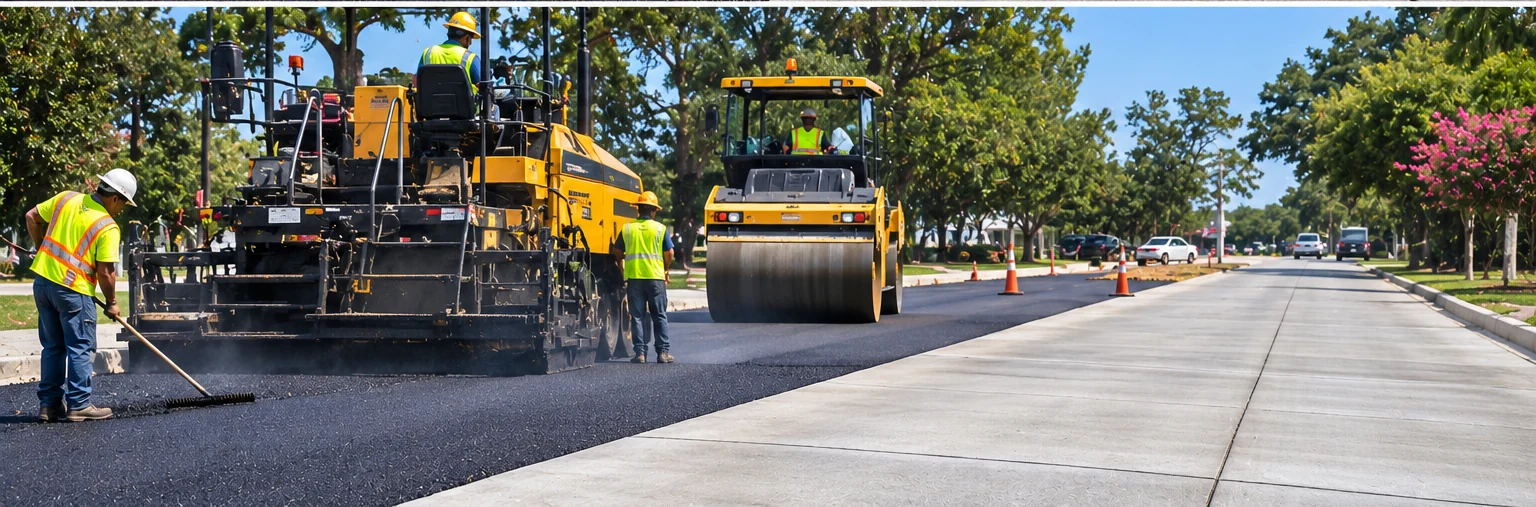
Professional paving equipment, proper installation, and stable foundations help create durable road surfaces suited to Louisiana’s traffic and weather conditions.
Appearance and Surface Finishes
Asphalt provides a smooth, dark surface that creates a consistent appearance across roads and parking areas.
Concrete typically has a lighter appearance and can accommodate various finishes, textures, and decorative treatments.
Both materials can be designed to provide suitable traction, although surface texture and ongoing maintenance affect skid resistance.
For commercial developments and private roads, appearance may influence the choice of material, but durability and functional requirements should remain the primary considerations.
Asphalt vs Concrete Roads Comparison Table
The following comparison highlights common differences between the two paving materials.
| Factor | Asphalt Roads | Concrete Roads |
|---|---|---|
| Initial installation cost | Generally lower | Generally higher |
| Installation time | Typically faster | Longer curing and reopening requirements |
| Typical service life | Often 15–25 years | Often 25–40 years or longer |
| Maintenance | Periodic crack repairs, patching, and possible resurfacing | Joint maintenance and localized slab repairs |
| Heavy vehicle loads | Performs well with appropriate pavement design | Often advantageous for concentrated or stationary heavy loads |
| Heat performance | Can experience rutting under heavy loads | Resists rutting but requires proper joint and curing practices |
| Repair process | Generally easier to patch or resurface | Some repairs require slab or panel replacement |
| Recycling | Reclaimed asphalt can be incorporated into new mixtures | Crushed concrete can be reused as aggregate |
| Appearance | Dark, uniform finish | Lighter surface with more finish options |
Service-life estimates are broad planning ranges, not guarantees. Actual pavement performance depends on traffic, design, construction quality, drainage, and maintenance.
Durability and Maintenance Requirements
Both asphalt and concrete can provide reliable roadway performance when installed over a stable foundation.
Asphalt’s flexibility allows it to accommodate certain pavement movements, but it remains vulnerable to cracking, rutting, oxidation, and water-related deterioration.
Concrete resists deformation under heavy loads but can develop cracks, joint deterioration, and settlement when construction or underlying conditions are inadequate.
Asphalt Road Maintenance
Asphalt roads benefit from regular inspections and preventive maintenance.
Common maintenance activities include:
- Sealing appropriate cracks to limit water infiltration
- Repairing potholes and localized pavement failures
- Maintaining drainage systems
- Resurfacing when the existing pavement structure remains suitable
- Applying protective surface treatments when appropriate
Prompt maintenance helps prevent minor problems from developing into more extensive pavement damage.
Concrete Road Maintenance
Concrete roads generally require less frequent surface treatment, but they are not maintenance-free.
Joint sealants may require inspection and replacement, and damaged slabs or panels may need professional repairs.
Cracking, settlement, and surface deterioration should be evaluated before they affect surrounding pavement.
Chris Paving provides concrete paving and repair services for streets, private roads, commercial properties, and other paved surfaces.
Asphalt vs Concrete Road Construction Costs
Cost is often one of the first considerations when comparing asphalt and concrete roads in Baton Rouge.
Asphalt typically has a lower initial construction cost, making it attractive for large paved areas and projects with limited upfront budgets.
Concrete generally requires a larger initial investment because of material costs, construction requirements, and curing time.
However, initial cost does not tell the entire story.
Property owners should also consider:
- Expected pavement service life
- Anticipated traffic and vehicle loads
- Routine maintenance expenses
- Potential resurfacing or reconstruction costs
- Drainage and foundation requirements
- Business disruptions during construction or repairs
A lifecycle cost comparison considers these expenses over the expected service period rather than focusing only on the installation price.
In some applications, asphalt offers the more economical solution. In others, concrete’s durability and maintenance characteristics may justify its higher upfront cost.
Comparing Asphalt and Concrete Road Lifespans
Asphalt roads commonly provide approximately 15–25 years of service before substantial rehabilitation may be necessary, although well-designed and maintained pavements can last longer.
Concrete roads often provide 25–40 years or more under suitable conditions.
These figures should be treated as general estimates rather than guaranteed lifespans.
Traffic volume, heavy truck loads, pavement thickness, drainage, construction quality, and maintenance practices all influence how long a roadway remains functional.
A properly constructed asphalt road can outperform poorly installed concrete, just as well-designed concrete can provide decades of dependable service.
The quality of the pavement structure matters at least as much as the material selected.
How Baton Rouge Weather Affects Road Pavement
Baton Rouge’s climate presents challenges for both asphalt and concrete pavement.
High temperatures, substantial rainfall, and moisture-sensitive soils can contribute to pavement deterioration when roads are not properly designed and maintained.
Heat and Heavy Traffic
During hot weather, asphalt pavement temperatures can become significantly higher than surrounding air temperatures.
Under heavy traffic loads, poorly designed asphalt mixtures may become susceptible to rutting or permanent deformation.
Concrete is generally more resistant to rutting, making it useful for certain heavy-load applications.
However, concrete also experiences thermal expansion and contraction, making appropriate joint design essential.
Heavy Rainfall and Drainage
Water is one of the most significant threats to roadway performance in Louisiana.
When water penetrates pavement cracks or accumulates beneath the surface, it can weaken supporting materials and contribute to settlement, cracking, and potholes.
Both asphalt and concrete require proper grading and drainage.
A well-designed pavement foundation helps direct water away from the roadway and reduces the risk of moisture-related damage.
Soil Conditions and Foundation Stability
Baton Rouge properties may encounter soil conditions that require additional attention during pavement construction.
Moisture-sensitive soils can expand, shrink, or lose strength as water conditions change.
Proper site evaluation, subgrade preparation, and base construction help provide a stable foundation for either paving material.
Without adequate support, even high-quality asphalt or concrete can deteriorate prematurely.
Environmental Impact and Recycling
Both asphalt and concrete have environmental impacts associated with material production, transportation, construction, and maintenance.
Asphalt contains petroleum-derived binder, but existing asphalt pavement can often be reclaimed and incorporated into new mixtures.
Concrete production involves cement manufacturing, which contributes substantially to greenhouse gas emissions. However, demolished concrete can be crushed and reused as aggregate, and some concrete mixtures incorporate supplementary cementitious materials.
The environmental performance of either material depends on its mixture design, recycled content, construction practices, service life, and maintenance requirements.
For additional technical information about pavement materials and performance, visit the Federal Highway Administration’s Pavements program.
Rather than assuming one material is always more environmentally friendly, property owners should consider the full lifecycle of the pavement.
Which Road Material Is Best for Baton Rouge?
There is no universal winner when comparing asphalt and concrete roads in Baton Rouge.
The best choice depends on how the road will be used, the condition of the site, and the project’s financial and operational requirements.
When Asphalt May Be the Better Choice
Asphalt is often attractive for projects where:
- Lower initial construction costs are a priority
- Fast installation and reopening are important
- Future resurfacing may be necessary
- The roadway will accommodate typical passenger and commercial vehicle traffic
- A smooth, dark pavement appearance is preferred
When Concrete May Be the Better Choice
Concrete may be appropriate when:
- Heavy or stationary vehicle loads are expected
- Resistance to rutting is particularly important
- A longer potential service life is a priority
- Higher upfront construction costs are acceptable
- A lighter surface or specialized finish is desired
Neither material eliminates the need for proper site preparation, drainage, and maintenance.
Key Factors to Consider Before Choosing
Before selecting a paving material, evaluate the following questions:
- How much traffic will the road carry? Heavy trucks and frequent vehicle movements may require a stronger pavement structure.
- What are the soil and drainage conditions? A stable foundation is essential for both asphalt and concrete.
- What is the available construction budget? Consider both initial costs and long-term maintenance.
- How quickly must the road reopen? Asphalt often offers an advantage when minimizing downtime is important.
- How long should the pavement remain in service? Consider expected use, maintenance plans, and future rehabilitation.
- Are there project specifications or local requirements? Public roads and some developments may require particular materials or construction standards.
An experienced paving contractor can evaluate these factors and recommend a suitable approach.
Choosing the Right Road Paving Material
When comparing asphalt vs concrete roads in Baton Rouge, the decision should be based on more than price or appearance.
Asphalt offers efficient installation, practical repair options, and generally lower initial costs. Concrete provides excellent load-bearing capabilities and the potential for a longer service life in appropriate applications.
Both materials can perform well in Louisiana’s climate when properly designed, installed, and maintained.
Chris Paving LLC provides professional asphalt and concrete paving services for private roads, commercial properties, subdivisions, and other paving projects throughout Baton Rouge and surrounding Louisiana communities.
Contact Chris Paving LLC today to discuss your road paving project and request a free estimate.