
When comparing an asphalt vs concrete driveway in Louisiana, longevity is often one of the first considerations. A properly designed and installed concrete driveway will generally have the potential to last longer than an asphalt driveway. However, in Southeast Louisiana, the material alone does not determine how long a driveway lasts. Drainage, the condition and preparation of the underlying soil, pavement thickness, construction quality, traffic loads, and maintenance can all affect service life.
That distinction matters in a region where heavy rainfall and warm temperatures put pavement to the test. New Orleans International Airport’s 1991–2020 climate normals show approximately 63.35 inches of precipitation per year, with normal summer high temperatures around 90–91°F.
So the better question for many Louisiana property owners is not simply “Does asphalt or concrete last longer?” It is:
Which driveway material makes the most sense for this property, its drainage, soil conditions, expected traffic, budget, and maintenance plans?
How Long Do Asphalt and Concrete Driveways Last?
There is no single reliable lifespan that applies to every Louisiana driveway.
A commonly cited planning estimate for residential asphalt driveways is roughly 15–20 years, although a well-built and well-maintained asphalt pavement can perform longer and a poorly constructed one can fail considerably sooner. An official state regulatory appendix incorporating building-component life-expectancy data, for example, lists asphalt driveways at 15–20 years.
Concrete generally has a longer potential service life. Rather than relying on a specific Louisiana driveway lifespan that has not been established by strong local research, it is more accurate to say that properly designed concrete pavements are intended as long-term pavement systems. The American Concrete Institute emphasizes the combination of pavement thickness, drainage, subgrade or subbase support, jointing, traffic, and environmental conditions in determining satisfactory long-term performance.
For either material, a lifespan number should therefore be treated as an estimate—not a warranty.
Why Is Southeast Louisiana Different?
Driveway advice written for other parts of the country does not always translate neatly to Southeast Louisiana.
Heavy Rainfall Makes Drainage Critical
Water management is one of the most important considerations for pavement.
The National Weather Service’s 1991–2020 normals show annual precipitation of approximately 63 inches at New Orleans International Airport. June alone averages more than 7.6 inches.
That does not mean rainfall automatically damages a properly constructed driveway. The problem develops when water is allowed to pond on the pavement, enter cracks, erode supporting material, or remain where the pavement structure needs stable support.
The Federal Highway Administration identifies drainage as a critical pavement consideration, while the American Concrete Institute likewise includes drainage and support conditions among the fundamentals of pavement design.
For a residential driveway, that makes proper grading and drainage part of the driveway system—not an afterthought.
The Ground Under the Driveway Matters
The visible asphalt or concrete is only the top of a pavement system.
Louisiana DOTD’s Pavement Design Unit evaluates shallow subgrade soils and considers properties including soil classification and water-table depth when determining appropriate pavement design and stabilization techniques. Depending on conditions, those techniques can include lime or cement treatment and geosynthetics.
A residential driveway is obviously not a state highway, and it should not be designed as one. But the engineering principle is directly relevant: pavement performance depends heavily on the material supporting it.
If the base or subgrade moves, settles, washes out, or was never properly compacted, even an excellent paving material can crack or deform.
How Does Louisiana Heat Affect Asphalt?
Asphalt is designed to remain somewhat flexible, which is one of its advantages. However, asphalt binder becomes less stiff as temperature increases.
FHWA research explains that increasing temperature decreases asphalt-binder stiffness and that high-temperature pavement design must consider resistance to permanent deformation, or rutting. Modern performance-graded asphalt binders are selected partly according to anticipated pavement temperatures and loading conditions.
This does not mean asphalt is unsuitable for Louisiana heat. Asphalt is used extensively in hot climates, including Louisiana. It means that mixture selection, pavement design, and proper compaction matter.
FHWA also notes that inadequate asphalt density increases permeability and susceptibility to water intrusion, raveling, and premature pavement distress.
For homeowners, the practical takeaway is simple: the quality of an asphalt installation matters at least as much as the fact that the driveway is asphalt.
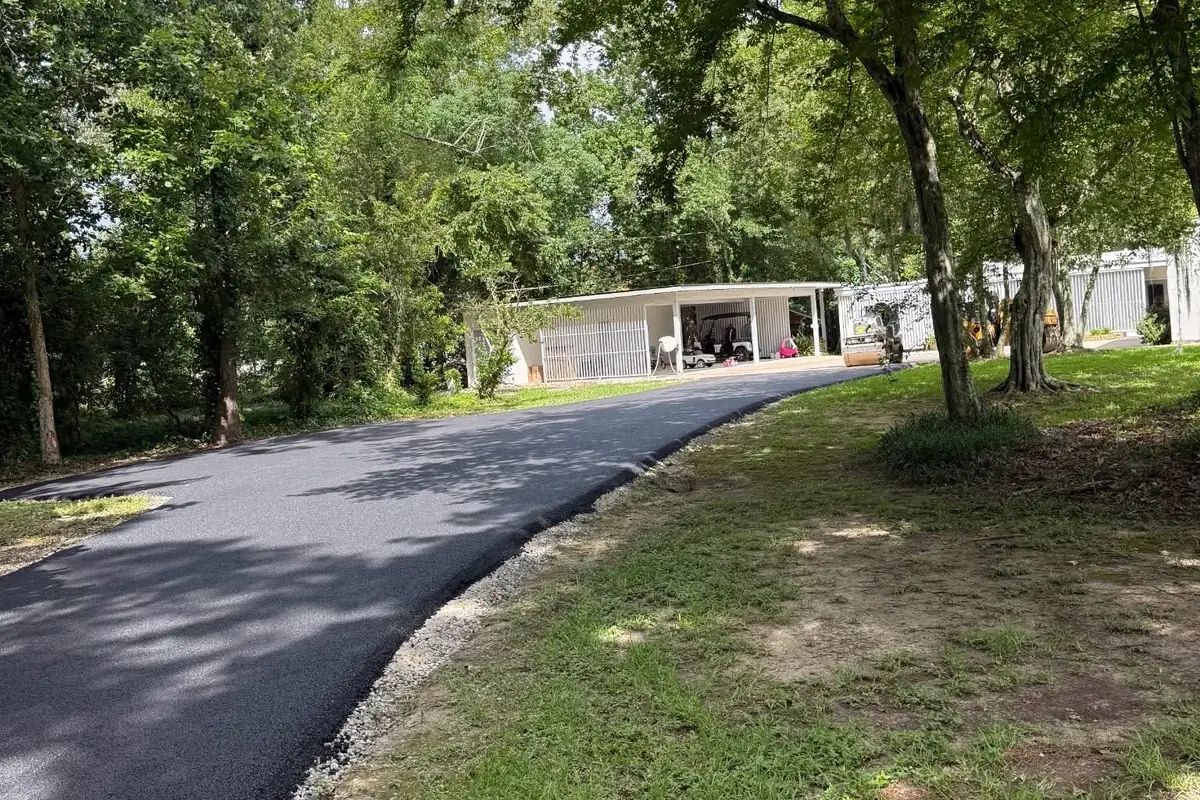
What Are the Advantages of an Asphalt Driveway in Louisiana?
Asphalt remains a practical driveway material for many Southeast Louisiana properties.
Its advantages can include:
- Generally lower initial installation cost than concrete
- A relatively quick installation process
- The ability to repair cracks, potholes and localized damage
- The possibility of resurfacing an existing pavement when its underlying structure remains suitable
- A flexible pavement structure that can accommodate some movement
Maintenance is part of owning asphalt, however.
The Asphalt Institute advises that a properly designed and constructed new driveway generally should not be sealcoated immediately. It states that low-traffic pavement such as a driveway or parking lot normally should not require sealing for approximately two to five years, depending on climate and the quality of the original work. Sealing becomes appropriate when aging asphalt becomes dry or brittle or begins developing small cracks, voids, or raveling.
That is considerably better guidance than automatically sealcoating new asphalt on an arbitrary schedule.
What Are the Advantages of a Concrete Driveway in Louisiana?
Concrete’s primary advantage in this comparison is its potential for a longer service life with relatively modest routine maintenance.
It also offers:
- High load-carrying capacity when properly designed
- Good resistance to permanent deformation under hot-weather vehicle loads
- A rigid, stable driving surface
- Multiple finishing options
- Less routine surface maintenance than asphalt in many applications
Concrete is not maintenance-free, and it is not immune to cracking.
Concrete naturally changes volume as it cures and as environmental conditions change. Proper joint design helps control where cracking occurs. The American Concrete Institute specifically addresses contraction joints for residential slabs-on-ground and includes subgrade preparation, jointing, and curing among the important elements of concrete flatwork construction.
If the supporting ground settles or erodes, concrete panels can also crack, shift, or become uneven.
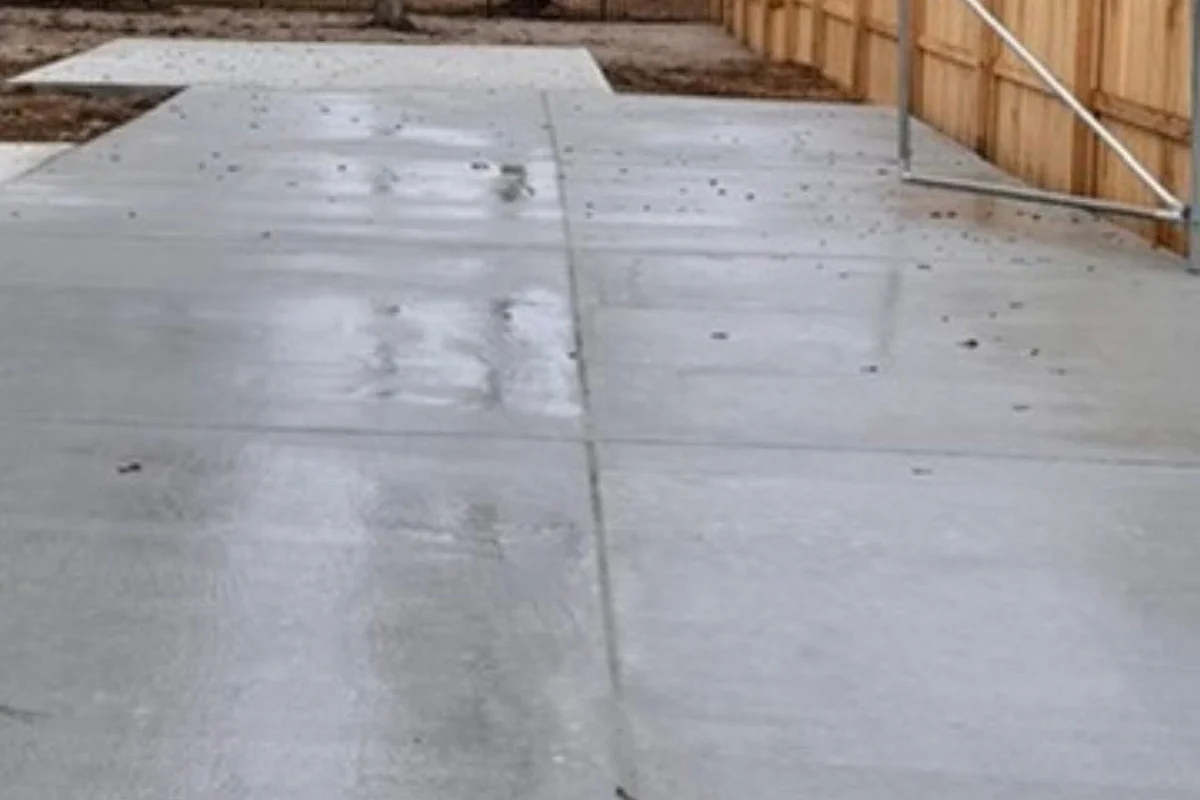
Which Material Handles Water Better?
Neither asphalt nor concrete should be expected to compensate for a poorly drained site.
A properly graded concrete driveway can shed water effectively, while a properly compacted asphalt driveway can do the same. Conversely, either pavement can develop problems when water repeatedly ponds, reaches an unstable base, or erodes material along its edges.
That makes the site’s drainage pattern an important part of deciding how a Southeast Louisiana driveway should be constructed.
Before replacing a driveway, it is worth asking:
- Where does stormwater currently flow?
- Does water pond on the existing driveway?
- Are low areas developing?
- Is soil washing away along the edges?
- Have sections settled?
- Are cracks recurring in the same locations?
Those symptoms may indicate that simply installing a new surface will not correct the underlying problem.
What Warning Signs Should Louisiana Property Owners Watch For?
Asphalt
Watch for cracking that continues to spread, potholes, depressions or ruts, loose aggregate, crumbling edges and areas where water remains after rainfall.
A few isolated cracks do not necessarily mean the entire driveway needs replacement. Localized repairs or maintenance may still be appropriate when the pavement and base remain structurally sound.
Widespread deterioration, repeated failures or substantial deformation can indicate that resurfacing alone will not solve the problem.
Concrete
Watch for widening or displaced cracks, settled or tilted panels, broken corners, extensive surface deterioration and evidence of erosion or loss of support beneath the slab.
A localized damaged section may sometimes be repaired or replaced individually. Widespread settlement or cracking throughout multiple panels may point to a larger base, drainage or pavement problem.
Is Repair, Resurfacing or Replacement the Better Choice?
The answer depends on why the existing driveway is failing.
If an asphalt driveway has a fundamentally stable base but an aged surface, repairs or an asphalt overlay may be practical. If the base has failed, placing new asphalt over the existing problem can simply transfer the failure into the new surface.
Concrete presents a similar issue. Replacing one damaged panel can make sense when deterioration is localized. But repeatedly repairing slabs that are moving because of poor support or drainage may address the symptom rather than the cause.
A pavement evaluation should therefore look beyond the visible cracks and consider grading, drainage, base stability, traffic, and the condition of the overall driveway.
Asphalt vs. Concrete Driveway in Southeast Louisiana: Which Should You Choose?
Choose based on the property rather than assuming one material is automatically right for every driveway.
Concrete generally has the advantage when maximum potential service life and lower routine surface maintenance are priorities.
Asphalt can be attractive when initial cost, repairability, resurfacing options, and flexibility are important considerations.
In Southeast Louisiana, however, both choices depend heavily on good site preparation and water management. Louisiana DOTD’s own pavement-design process demonstrates how important subgrade conditions and water-table considerations are to pavement performance, even though residential driveway designs are much simpler than highway projects.
A well-designed asphalt driveway can be a better investment than poorly constructed concrete—and well-built concrete can substantially outlast an inadequately prepared driveway of either material.
Frequently Asked Questions
Does concrete last longer than asphalt in Louisiana?
Generally, concrete has the potential for a longer service life than asphalt when both are properly designed, installed and maintained. Actual lifespan depends on drainage, subgrade and base conditions, pavement thickness, traffic, construction quality and maintenance.
How long does an asphalt driveway last in Louisiana?
There is no authoritative Louisiana-specific residential lifespan that applies to every driveway. A commonly cited planning range is approximately 15–20 years, but actual performance can be shorter or longer depending on construction, drainage, traffic, climate, and maintenance.
Is asphalt too hot for Louisiana?
No. Asphalt is widely used in hot climates. However, asphalt binder properties change with temperature, which is why pavement engineers use performance-graded binders and design asphalt mixtures with high-temperature performance in mind.
Should a new asphalt driveway be sealcoated immediately?
Generally, no. The Asphalt Institute states that a well-designed and constructed low-traffic pavement such as a driveway should normally not require sealing for approximately two to five years, depending on climate and the quality of the original work.
Is drainage really that important for a driveway?
Yes. Both FHWA and ACI pavement guidance emphasize drainage or support conditions as important to pavement performance. In Southeast Louisiana, where New Orleans averages roughly 63 inches of precipitation annually, directing water away from the pavement and protecting its supporting materials deserves particular attention.
Choosing the Right Driveway for Your Louisiana Property
The answer to asphalt vs. concrete driveway in Louisiana is not as simple as picking whichever material has the larger lifespan number.
Concrete generally offers greater potential longevity. Asphalt offers advantages in initial cost, repairability and resurfacing. But either can perform poorly when installed over an inadequate base or on a site with unresolved drainage problems.
Chris Paving LLC installs and repairs asphalt and concrete surfaces throughout Greater New Orleans, the Northshore, Southshore and other Southeast Louisiana communities. The right starting point is an evaluation of the existing pavement, drainage, intended use, and site conditions before deciding whether asphalt, concrete, repair, resurfacing, or complete replacement is appropriate.
Sources Used
- National Weather Service – New Orleans/Baton Rouge: 1991–2020 climate normals for New Orleans and surrounding locations, including temperature and precipitation data.
- Louisiana Department of Transportation and Development – Pavement Design: Louisiana-specific information on pavement design, subgrade analysis, soil properties, water-table depth and stabilization.
- Federal Highway Administration: Technical guidance and research concerning pavement drainage, asphalt density, temperature effects, and performance-graded asphalt binders.
- Asphalt Institute: Technical guidance concerning sealcoating and maintenance of asphalt driveways and low-traffic pavements.
- American Concrete Institute: Guidance concerning concrete pavement support, drainage, subgrade/subbase preparation, jointing, and residential slabs-on-ground.